TL;DR: On June 3, 2026, a Cloudflare network incident knocked Shopify offline for roughly 2 hours starting at 9:27 a.m. EDT. Storefronts, checkouts, admin dashboards, and Retail POS all failed with “500 Internal Server Error” messages. Over 3,000 outage reports flooded Downdetector before 9 a.m. ET. D2C brands running paid ads during the window lost sales and burned budget on traffic that couldn’t convert.
What Happened?
At 9:27 a.m. EDT on Wednesday, June 3, 2026, Shopify confirmed a partial outage affecting five core systems:
- Shopify Admin
- Checkout
- Storefronts
- Retail POS
- Shopify Support
By 10:37 a.m. EDT, Shopify reported recovery from mitigation efforts. The incident was officially resolved by 11:31 a.m. EDT — a ~2-hour disruption. Cloudflare’s status page, in parallel, logged an “Increased 5XX error rate on Browser rendering” and “Network Performance Issues” lasting several hours the same morning. Many merchants saw a Cloudflare-branded 500 error on their storefronts, confirming the upstream link.
Why Did It Happen?
Shopify, like a huge portion of the modern web, routes traffic through Cloudflare’s CDN and edge network for performance, DDoS protection, and DNS. When Cloudflare’s edge layer returns 5XX errors, every dependent service — including Shopify storefronts — becomes unreachable, even if Shopify’s own servers are healthy.
This is the classic single-point-of-failure problem in modern internet infrastructure: a handful of providers (Cloudflare, AWS, Azure, Google Cloud) sit between users and almost every website. One bad config push or regional network issue cascades globally within minutes.
The Real Cost for D2C Stores
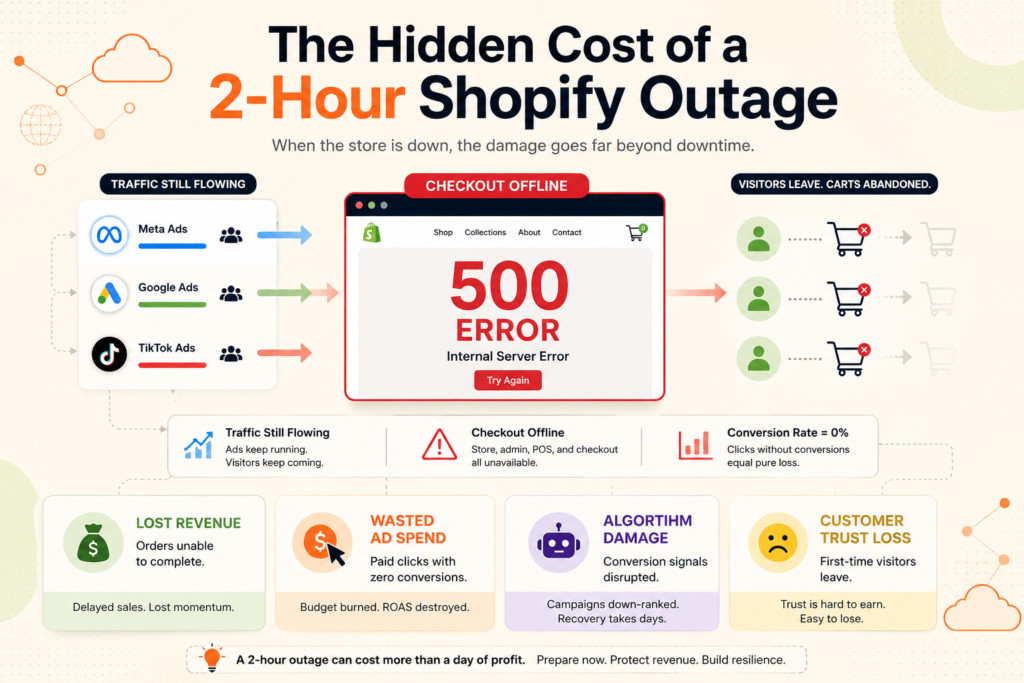
A 2-hour outage during a US morning window is more painful than the duration suggests:
- Lost revenue: Shopify processes billions in GMV; a 2-hour global window can translate to tens of millions in delayed or abandoned sales.
- Wasted ad spend: Meta, Google, and TikTok kept serving ads. Clicks landed on broken stores. CPCs were paid; conversions were not.
- Skewed campaign data: Algorithms recorded the outage as “low conversion traffic” and may down-rank winning creatives for days.
- Customer trust hit: First-time visitors who saw a 500 error rarely come back.
- POS dead in-store: Brick-and-mortar Shopify merchants couldn’t ring up sales at the counter.
A Short History of Cloudflare Outages (and Why This Keeps Happening)
| Date | Trigger | Major Services Hit |
|---|---|---|
| June 21, 2022 | Network config error | Shopify, Discord, Peloton |
| Nov 18, 2025 | Internal service degradation | ChatGPT, X, Shopify, Coinbase |
| Dec 5, 2025 | Firewall change after CVE patch | LinkedIn, Zoom, Shopify, HSBC |
| Mar 14, 2026 | Database permissions error | Shopify, AI chatbots, multiple SaaS |
| Jun 3, 2026 | Edge 5XX errors / network issue | Shopify (admin, checkout, POS) |
The pattern is clear: the failures are usually not attacks. They’re configuration changes, permission errors, and routine maintenance that go sideways at scale.
The Hidden Benefit: Industry Wake-Up Call
Every outage forces three good things:
- Cloudflare publishes a detailed root-cause analysis — improving the entire industry’s playbook.
- Shopify accelerates investment in multi-CDN failover.
- Smart D2C founders finally build the resilience plans they’ve been postponing.
What D2C Founders Should Do Right Now (Action Checklist)
You can’t replace Cloudflare or Shopify. But you can soften the blow.
- Pause ads automatically during downtime. Use tools like Revealbot, Shape, or a simple custom script tied to a Shopify health check. This alone can save thousands per outage.
- Set up an outage alert. Subscribe to Shopify Status and Cloudflare Status via email/SMS. Add a Downdetector watch.
- Pre-write a customer comms template. A simple “We’re experiencing technical issues — your order is safe” email and Instagram Story is ready to deploy in 60 seconds.
- Capture email at the edge. Use a static landing page (hosted on a different provider like Vercel or Netlify) with an email capture form. If the store dies, you still grow the list.
- Diversify checkout. Offer Shop Pay, Apple Pay, PayPal, and a WhatsApp/DM order option so motivated buyers have a fallback path.
- Cache critical pages. Tools like Hyperlane or Shopify’s own Hydrogen + Oxygen reduce dependence on real-time edge responses.
- Audit your tech stack. Map every third-party app — if 5 of them all sit behind Cloudflare, you have hidden concentration risk.
What the Future Looks Like
Expect three shifts over the next 12–24 months:
- Multi-CDN becomes standard for serious D2C brands above $5M ARR.
- Shopify will likely add native multi-edge routing — they have the scale to demand it.
- Outage insurance and ad-pause automation will become a real SaaS category.
FAQ
Was Shopify down on June 3, 2026?
Yes. Shopify experienced a partial outage from approximately 9:27 a.m. EDT until 11:31 a.m. EDT on June 3, 2026, affecting Admin, Checkout, Storefronts, Retail POS, and Support.
Was the Shopify outage caused by Cloudflare?
The outage coincided with a Cloudflare network incident that produced elevated 5XX errors. Merchants reported Cloudflare-branded 500 error pages, indicating the upstream CDN layer was the root of the disruption.
How long did the Shopify outage last?
Roughly 2 hours from official acknowledgment to resolution.
How can I protect my D2C store from future outages?
Pause ads on downtime triggers, set up status alerts, prepare customer comms templates, diversify payment methods, and consider multi-CDN architecture if you’re at scale.
How often does Cloudflare go down?
Cloudflare has had at least 4–5 publicly significant outages in the past 12 months (Nov 2025, Dec 2025, Mar 2026, June 2026), though most last under 90 minutes.
Did this outage cost your store sales? Share your story in the comments — and bookmark this guide for the next one (because, statistically, there will be a next one).
Want this run on
your accounts?
Tell us what you're working on and we'll suggest a useful next step.
